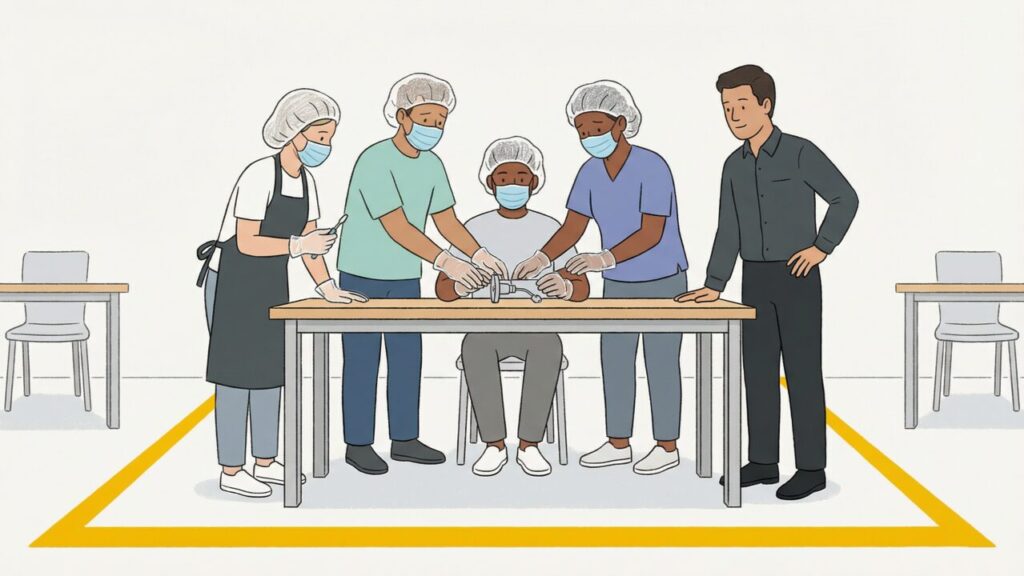
There is a requirement in FDA 21 CFR Part 820.25 that most companies quietly dread. Not because it is complicated. Because it is honest.
It requires that personnel be made aware of the device defects that can result from the improper performance of their specific jobs.
Read that again. Not the regulation. Not the procedure. The defects. The ones caused by their hands. By their decisions. By their inattention on a Tuesday afternoon in the third hour of a shift.
Most companies respond to this requirement with a slide deck. Some companies do something else.
The Video
I worked at a company that manufactured respiratory equipment for neonatal intensive care units: humidifiers, breathing circuits, cannulas. Devices used to keep premature newborns alive.
When it came time to deliver consequences awareness training to production operators, the training team did not open PowerPoint.
They showed a video.
On screen: a real premature baby in a real NICU, small enough to fit in the palm of a hand, surrounded by exactly the equipment being assembled on the production floor thirty meters away.
There was no narrator. No animation. No bullet points.
Just the image, and the room, and the silence.
Nobody looked at their phone.
At the end of the video, the baby is delivered to his mother. You hear the cry. Somewhere in the room, someone wiped a tear.
Whoever designed that training was not just following a regulation. They were smart enough to understand that compliance lives in the head, but quality lives somewhere deeper. And creative enough to find a way to reach it.
What the Regulation Is Actually Asking For
FDA 820.25 does not ask you to prove that operators sat through a presentation. It asks you to demonstrate that they understand the consequences of their work.
That is a fundamentally different standard.
A slide can inform. A video of a premature infant connected to the device you built this morning does something else entirely. It collapses the distance between the production floor and the patient. It makes abstract stakes concrete. It answers the question that no compliance training ever quite answers: why does this matter to me, personally, today?
The operators in that room did not walk out thinking about regulatory requirements. They walked out thinking about who was at the end of the line.
That is what effective consequences awareness training looks like.
Three Approaches, One Honest Comparison
Across different companies and different products, I have seen this requirement handled three ways:
The PowerPoint approach. Device overview, intended use, consequences of manufacturing errors. Covers the requirement. Clears the audit. Stays abstract. Operators know they are sitting through a compliance exercise and the information rarely survives the following week.
The data approach. At a company producing continuous glucose monitoring devices, training included global diabetes prevalence, patient stories, and real data on what a defective reading means for someone managing their condition in real time. Each employee was given a device to wear personally. Feeling what the patient feels made the stakes real in a way that no slide could replicate.
The image approach. The NICU video. No narration needed. The image does the work.
All three meet the regulatory requirement. Only two of them meet the intent.
The Question Worth Asking
Before your next audit, before your next onboarding cycle, ask yourself one question:
Could a new employee, one week after onboarding, tell you who uses your product — and what could happen if they make a mistake?
Not what the regulation says. Not what the SOP requires. What could happen. To whom.
If the answer is yes, your training is doing its job.
If the answer is uncertain, you have a slide deck masquerading as awareness.
The regulation gives you the requirement. The patient gives you the reason. The best training programs make sure the operators never confuse the two.