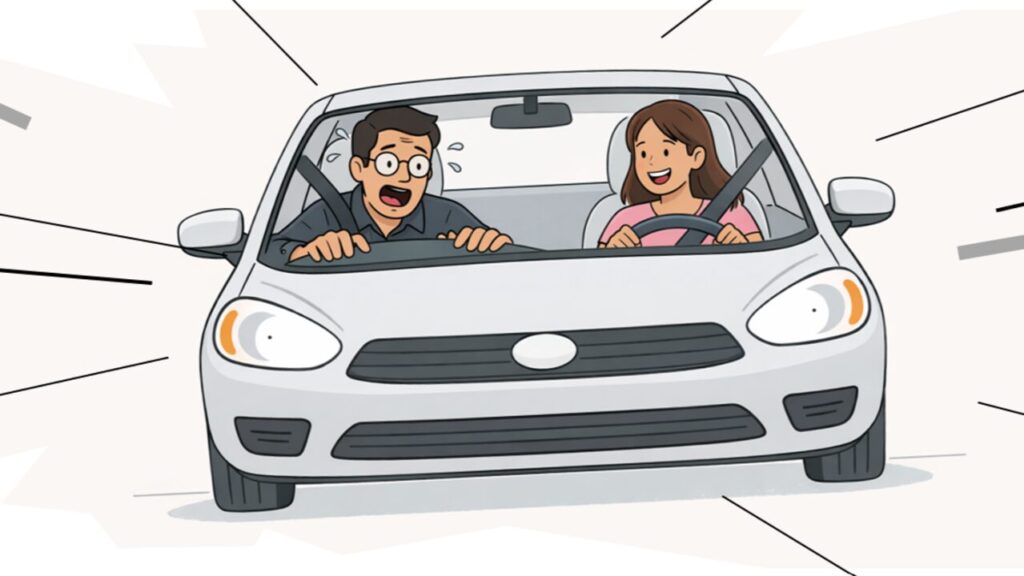
There comes a moment in every father’s life. The moment when he has to teach his teenage daughter to drive.
The idea that this high‑energy, temperamental girl is about to operate a 2,000‑pound machine at 40 miles per hour genuinely terrifies me. But college is coming, and she needs to move through the world on her own.
So, on Saturday morning we drive out to an empty parking lot in the industrial area on the edge of town, and we begin the practical training.
I say practical training deliberately — because she has done everything else already. She watched YouTube tutorials. She watched the DMV safety videos. She completed the online course. She passed the written exam. She even read the old Toyota Corolla owner’s manual. The whole thing.
If this were training in a manufacturing plant, a lot of people would look at that list and say: she’s good to go. She’s in compliance. Check the box.
Everyone knows you don’t actually learn to drive by reading the manual. So why do we believe that reading a procedure is sufficient training for someone building a medical device or operating a critical station?
So we begin the training the way it should be done: on the job, from the beginning.
Step One: Prepare the Learner (Don’t Just Hand Them the Keys)
Before that Saturday, we had done the right things. She had read the driver’s handbook, watched instructional videos, taken the written test and passed it. She understood — in theory — that a red light means stop, mirrors exist for a reason, and the speed limit is not a suggestion.
None of that prepared her for the feeling of the car moving. The way the wheel resists and then gives. The way the brake grabs harder than you expect. The way the car drifts slightly when you take your eyes off the road to check the speedometer.
She was not unprepared because we had failed. She was unprepared because reading about something and doing it are different experiences. The preparation phase matters — it creates awareness, context, and a baseline of knowledge. But it is not training. It is the prologue to training.
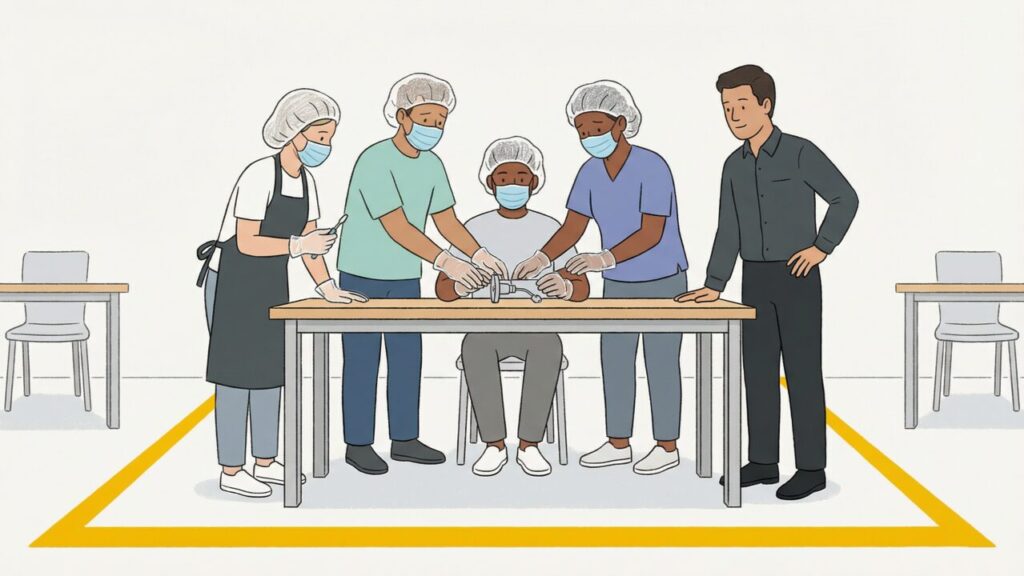
In manufacturing, I have watched this play out hundreds of times. A new operator arrives, reads the work instruction, signs the acknowledgment form, and is sent to the line. The supervisor checks the box. Training: complete.
What follows is not production. It is a very expensive driving lesson with no parking lot.
Step Two: Show Them First — And Explain the Why
Before she moved the car, I sat in the driver’s seat and went through everything. Engine off first — the dashboard lights, what each one means. Then engine on, hands on the wheel, brake applied, the feel of the gear selector.
I narrated out loud: what I was doing, why I was doing it, what would happen if I didn’t. I said things like: “The reason you keep both hands on the wheel at ten and two is not because the manual says so — it’s because when something unexpected happens, your instinct will be to grab, and you need something to grab.”
The reason behind the rule matters more than the rule itself. A person who understands why will follow the instruction even when they’re tired, distracted, or under pressure. A person who only knows what — without knowing why — will forget it the moment their attention is pulled somewhere else.
I know a plant manager who solved a long‑running quality problem by doing exactly this. Operators had been told “do not skip the visual inspection step.” The instruction was in the procedure. It was repeated in every shift meeting. The step kept getting skipped.
He brought an assembly from a customer return to the floor and set it on the table. He showed everyone exactly what a defect that passed inspection looked like, what it caused for the customer, and what it cost the company. He did not give a presentation. He showed them the thing.
The step stopped being skipped.
Step Three: Let Them Drive — And Stay Quiet
This is the hardest part. For the trainer, not the trainee.
When my daughter took the wheel, I had to resist an overwhelming instinct to narrate everything in real time — every slight drift toward the curb, every late brake, every moment where she was looking at the hood instead of the road.
If you talk constantly while someone is learning, they stop listening and start performing — which are completely different things. Performing means trying to do what you think the observer wants to see. Learning means building a real internal map of the skill. You cannot build the map while someone is drawing it for you, out loud, in real time.
I let her make mistakes. I let her brake too softly and feel the car take longer to stop than she expected. I let her drift to the right and feel the visual cue of the curb getting closer before I said anything. I waited until after the moment to explain, not during it.
And then — this is the part most trainers skip — I asked her to explain back to me what she had just done. Not “what did I tell you,” but “tell me what you were doing and why.”
When a person can explain something in their own words, they own it. It is no longer your knowledge that you handed to them temporarily. It is their knowledge now. And their knowledge travels with them to every shift, every station, every situation you never planned for in the work instruction.
In our industry, we call this “why‑based training.” I’ve also heard it called common sense. Either way, most facilities are not doing it.
The parking lot we used was, by design, a safe space to fail. No traffic, no stakes, no production targets. We do not always have that luxury on the floor, which is exactly why the parking lot needs to exist before we go anywhere near the road.
Step Four: The Follow‑Up (Where Most People Stop Paying Attention)
By week three, she was confident. Maybe a little too confident.
She had stopped checking her mirrors at every turn. She was glancing, not scanning. She was braking a little later than before, which in an empty parking lot is imperceptible but on a real road with real cars is the kind of thing that changes your afternoon significantly.
This is one of the most important things I know about training: the degradation of good habits is invisible until it isn’t.
In manufacturing, we certify operators and then we move on. We have more people to certify, a validation to prepare, a customer audit in six weeks. We certify and we move.
Six months later, during an internal audit or a customer complaint investigation, we discover that the step has been drifting. Slowly. Gradually. In a way that no single shift supervisor noticed because each day it was slightly worse than the day before, and the day before had looked fine.
Follow‑up is not a courtesy. It is a quality control step.
I drove with my daughter every weekend for three months after that first parking lot session. Mostly I was quiet. Occasionally I pointed something out. A few times I asked her to pull over and we talked through a situation.
By the end, she was not driving because I had certified her. She was driving because she had genuinely learned.
There is a difference. The certification is the paperwork. The learning is the thing.
Now Let’s Talk About Your Plant
You probably don’t have a teenager in your plant. But I will bet you have operators who were handed the keys too soon.
I have been in manufacturing for over sixteen years — medical devices, automotive, aerospace, electronics, aviation. In every one of those industries, I have seen the same scene play out with almost no variation:
- A new line is launching and the schedule is tight.
- Engineering releases the work instructions that morning.
- The line leader, who is an excellent operator but has never been trained to train, pairs each new person with someone “experienced.”
- The experienced person shows them the basics once. The new person watches. The line leader checks the box.
Two weeks later, the same line is generating defects. Three different operators at the same station are doing the same step three different ways. No one can explain why, because the person who trained them can’t either.
The root cause, almost always: the training was an event, not a process.
What my daughter reminded me is that skill is not transferred through proximity. You cannot learn to drive by sitting near someone who drives well. You cannot learn a workstation by watching someone perform it once and signing a form.
Skill is built through structure, repetition, feedback, and time. There is no shortcut. The only variable is whether the shortcut costs you a small amount of time now or a large amount of money later.
Three questions worth asking about your training program right now:
- When your line trainers demonstrate a step, do they explain the reason behind each key point — or just show what to do?
- Does your certification process require operators to explain steps out loud, or just perform them in front of an observer?
- After certification, when is the last time someone actually observed that station — not to audit it, but to check whether the habits are holding?
If any of those questions made you pause, you already know where the gap is.
My daughter passed her driving test on the first attempt. The examiner told her she had good instincts.
She does not have good instincts. She has three months of structured practice, and a very patient instructor.
We call the result “talent” when it works and “human error” when it doesn’t. Most of the time, it is neither. It is training — or the absence of it.
I help manufacturing and quality leaders in regulated industries design training that closes this gap — reducing defects, complaints, and “human error” by building real capability on the floor.
#ManufacturingTraining #QualitySystems #OnTheJobTraining #MedicalDevices #ManufacturingLeadership